Enterprise digital marketing: 5 strategies for growth
Discover 5 advanced digital marketing strategies for enterprises. Learn how to fix measurement gaps, optimise budgets, and drive scalable growth in 2026.
Start reading
Despite years of significant investment in digital channels, 80% of enterprises still struggle to measure impact across multichannel strategies. That is not a technology failure. It is a strategic one. At enterprise scale, the complexity of coordinating paid media, content, data infrastructure, and internal teams creates friction that erodes returns and obscures accountability. This guide cuts through that complexity, presenting advanced frameworks, current budget benchmarks, and proven strategies that marketing executives at large organisations can apply immediately to drive measurable, scalable growth.
Table of Contents
- Why digital marketing at enterprise scale is different
- Key strategic drivers for enterprise marketing transformation
- Budget allocation and martech: Where enterprises invest (and what to fix)
- Measurement and metrics: From data silos to real business impact
- Enterprise content strategy: Quality, relevance, and ABM at scale
- AI in the enterprise marketing stack: Opportunities and governance
- Real-world success: Enterprise case studies in digital transformation
- Transform your enterprise with tailored digital marketing solutions
- Frequently asked questions
Key Takeaways
Point | Details |
|---|---|
Integrated measurement is vital | Enterprises that unify their metrics see sharp drops in digital marketing challenges and gain a clearer view of ROI. |
Strategic content and ABM win | Content quality and account-based approaches deliver proven boosts in enterprise marketing effectiveness. |
Smart budget allocation matters | Flat budgets require smarter investments in paid media and internal skills to drive maximum impact. |
AI adoption requires governance | Widespread enterprise AI use must be matched with strong policies for privacy and cost control. |
Transformation delivers results | Case studies show that advanced tools and integrated strategies lead to major revenue and conversion gains. |
Why digital marketing at enterprise scale is different
Enterprise digital marketing is not simply a larger version of what smaller organisations do. The structural differences are fundamental. Where an SMB might manage two or three channels with a lean team, a large enterprise contends with dozens of channels, multiple business units, fragmented data systems, and competing internal priorities. The result is a landscape where misalignment is not just possible, it is almost inevitable without deliberate governance.
The core challenges enterprises face include:
- Channel fragmentation: Paid search, organic, social, OTT, email, and programmatic all generating data in separate systems
- Data silos: Marketing, sales, and customer success teams operating on disconnected platforms
- Internal complexity: Multiple stakeholders, approval chains, and conflicting KPIs slowing execution
- Measurement gaps: No single source of truth for cross-channel attribution
As Gartner notes, scale amplifies alignment and measurement challenges, requiring more holistic approaches than most enterprises currently employ. Understanding digital transformation strategies at a structural level is the starting point for closing this gap.
“The cost of misalignment does not grow linearly with scale. It compounds. Every disconnected system, every siloed team, and every unmeasured channel multiplies the inefficiency.”
Research into enterprise content marketing effectiveness consistently shows that organisations investing in integrated strategies outperform those managing channels in isolation. Ruthless prioritisation, not broader coverage, is what separates digital leaders from laggards.
Key strategic drivers for enterprise marketing transformation
With a clear sense of the unique landscape, let us break down the critical drivers that consistently separate digital leaders from laggards at the enterprise level. Gartner identifies five key drivers that define enterprise marketing success in 2026:
- Experience clarity: Defining precise customer journeys and aligning all digital touchpoints to those journeys, eliminating ambiguity in how your brand is experienced
- Multichannel orchestration: Managing web, search, social, and OTT as an integrated ecosystem rather than independent channels, ensuring consistent messaging and data flow
- Advertising optimisation: Applying data-driven insights to continuously refine targeting, creative, and spend allocation across all paid channels
- Privacy and first-party data: Building compliant data strategies that leverage first-party signals and AI to personalise at scale without violating evolving privacy regulations
- Advanced measurement: Moving beyond last-click attribution to holistic performance frameworks that connect marketing activity to genuine business outcomes
These drivers are not sequential. They operate simultaneously, and weakness in any one area limits the effectiveness of the others. Enterprises that align their enterprise strategy steps to all five drivers consistently outperform those focused on only one or two.

Statistic to note: Enterprises that address all five drivers report significantly higher confidence in their ability to demonstrate marketing ROI to the board, a critical capability as budget scrutiny intensifies.
Budget allocation and martech: Where enterprises invest (and what to fix)
Understanding the strategic drivers is crucial, but how do enterprises actually allocate resources to bring these priorities to life? Current marketing budget benchmarks reveal a clear picture of where large organisations are directing spend in 2026.
Budget category | Typical allocation | Key trend |
|---|---|---|
Paid media | 30.6% | Increasing |
Martech | 22.4% | Decreasing |
Labor | 21.9% | Decreasing |
Agencies | 20.7% | Stable |
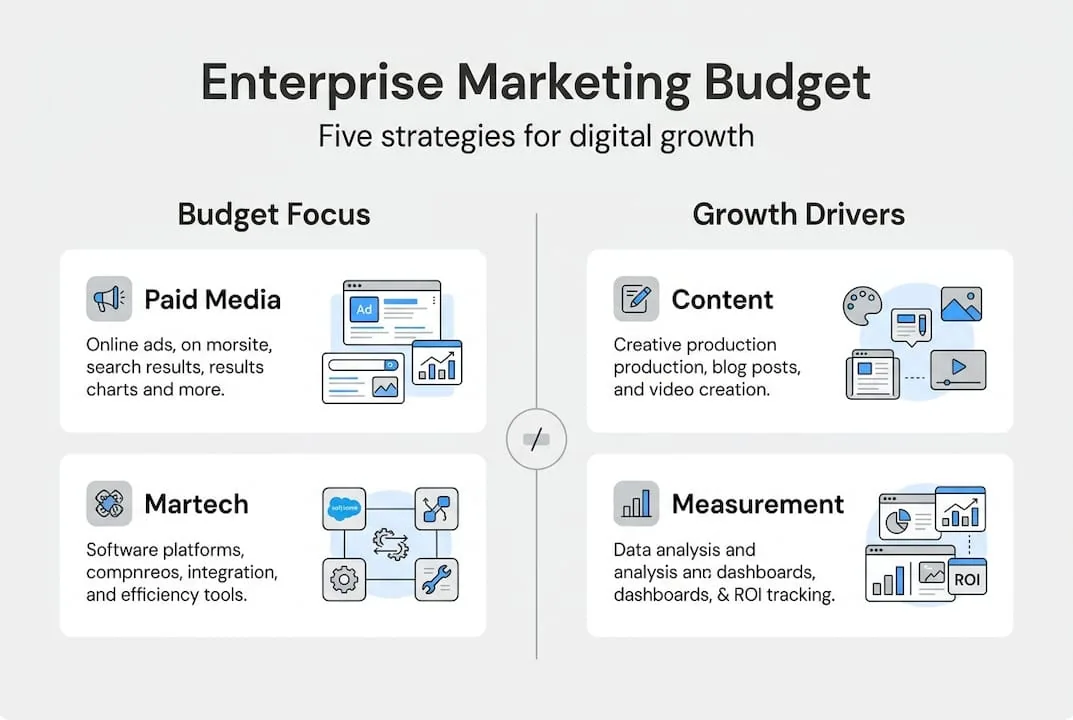
With overall budgets remaining flat, the pressure to extract more value from existing spend is acute. The data signals a strategic shift: enterprises are investing more in paid media performance while scrutinising martech and agency costs more aggressively. The risk is that cutting martech investment without first optimising the stack creates capability gaps that undermine paid media returns.
Exploring enterprise tech budget trends reveals that the most effective organisations are not simply cutting costs. They are consolidating redundant tools, upskilling internal teams, and building more flexible technology ecosystems that reduce dependency on expensive external agencies.
Pro Tip: Before reducing your martech budget, conduct a full stack audit. Identify tools with overlapping functionality and consolidate. The savings can be redirected to internal capability building, which delivers compounding returns over time.
Measurement and metrics: From data silos to real business impact
Budgets may be fixed and resources reallocated, but true digital transformation hinges on one thing: can your team measure what matters across the enterprise? This is where most organisations stall. The challenge is not a lack of data. It is an excess of disconnected data that produces noise rather than insight.
A holistic measurement approach reduces enterprise measurement issues from 86% to 67%, a meaningful improvement, but one that still leaves significant room for progress. The gap between siloed and integrated measurement is substantial:
Measurement approach | Data visibility | Attribution accuracy | Decision speed |
|---|---|---|---|
Siloed systems | Channel-level only | Last-click or single-touch | Slow, manual reporting |
Integrated platforms | Full-funnel, cross-channel | Multi-touch, algorithmic | Real-time dashboards |
Enterprise metrics worth tracking span four categories:
- Transactional: Revenue, conversion rate, average order value
- Competitive: Share of voice, search visibility, market penetration
- Engagement: Time on site, content interaction, email open and click rates
- Pipeline: Lead quality, sales cycle length, marketing-sourced revenue
Understanding digital measurement adoption at an organisational level is essential before selecting platforms. Technology alone does not solve measurement problems. The underlying data governance, team alignment, and metric definitions must be established first.
Enterprise content strategy: Quality, relevance, and ABM at scale
Measurement underpins every digital activity, and nowhere is this more critical than in your content programme. Research shows that 68% of enterprise marketers rate their content as effective, with quality, team skill, and measurement identified as the top differentiating factors. That means nearly a third of enterprise content programmes are underperforming, often because investment in content creation is not matched by investment in content strategy and team capability.
Account-based marketing (ABM) is a targeted approach where marketing and sales align to pursue specific high-value accounts with personalised content and outreach. At enterprise scale, ABM delivers measurable results: 20% of enterprises report significant impact, while 48% report moderate sustained improvement.
Three steps consistently improve enterprise content outcomes:
- Content relevance: Map content assets to specific buyer journey stages and account segments, eliminating generic content that fails to move prospects forward
- Team enablement: Invest in content strategists, not just content creators. The ability to plan, govern, and measure content is as important as the ability to produce it
- Integrated measurement: Connect content performance data to pipeline and revenue metrics, making the business case for content investment visible to leadership
Exploring enterprise content marketing strategies reveals that organisations combining ABM with strong content governance consistently outperform those treating content as a volume exercise. Quality and strategic alignment, not output volume, drive results.
Statistic to note: 95% of enterprises are now leveraging AI in content creation, but most remain in early or exploratory stages, meaning the competitive advantage for those who operationalise AI effectively is still significant.
AI in the enterprise marketing stack: Opportunities and governance
Sophisticated content and multichannel strategies thrive when powered by the right technology. AI offers transformative capability for enterprises, but only when its risks are managed with the same rigour applied to any other critical business system. The 95% enterprise AI adoption rate masks a more nuanced reality: most organisations are experimenting, not operationalising.
The primary opportunities AI creates for enterprise marketing include:
- Content creation at scale: Generating, personalising, and optimising content across channels and audience segments without proportional increases in headcount
- Customer insight: Analysing behavioural data to identify patterns, predict intent, and surface actionable segments that manual analysis would miss
- Performance optimisation: Automating bid management, creative testing, and audience targeting in real time across paid channels
The risks are equally significant. Budget overruns from poorly governed AI tools, data privacy failures from non-compliant AI processing, and a lack of human oversight creating brand or compliance exposure are all documented concerns. Understanding enterprise AI adoption principles is essential before scaling any AI initiative.
Reviewing AI in enterprise marketing and AI strategy best practices provides a practical foundation for building governance frameworks that enable innovation without exposing the organisation to unnecessary risk.
Pro Tip: Build AI governance into your martech stack from day one. Define which data AI tools can access, establish human review checkpoints for AI-generated outputs, and audit AI decisions quarterly. Governance is not a constraint on AI value. It is what makes AI value sustainable.
Real-world success: Enterprise case studies in digital transformation
Theory and frameworks are only as good as the results they produce. Two world-class examples demonstrate what is achievable when technology, measurement, and strategic focus converge.
Enterprise | Strategy applied | Result |
|---|---|---|
Marks & Spencer | Performance Max advanced tools | |
Cathay Pacific | Real-time data and personalisation | 53x conversion uplift |
Both cases share a common thread: neither organisation achieved these results by simply increasing spend. They achieved them by applying more sophisticated measurement, tighter channel integration, and technology that enabled real-time decision-making.
“Innovation at enterprise scale is not about doing more. It is about doing the right things with greater precision, speed, and accountability than your competitors.”
These benchmarks are not outliers. They represent what becomes possible when the strategic drivers outlined earlier are operationalised with discipline. Grounding your approach in ethical digital strategy ensures that the pursuit of performance does not create reputational or compliance risk along the way.
Transform your enterprise with tailored digital marketing solutions
Having seen what is possible with world-class enterprise strategy and technology, the next step is translating these frameworks into execution within your specific organisational context. At CloudFusion, we work with large enterprises to design and implement digital strategies that are custom-built for scale, complexity, and measurable outcomes. Our custom web development services and enterprise branding solutions are engineered to support the kind of integrated, data-driven digital presence that enterprise growth demands. Whether you are restructuring your martech stack, launching an ABM programme, or rebuilding your measurement infrastructure, we bring the technical depth and strategic expertise to accelerate your results. Get a digital marketing consultation and let us map a path forward that is specific to your enterprise’s goals.
Frequently asked questions
What are the biggest digital marketing challenges for enterprises in 2026?
The primary challenges are effective multichannel measurement, cross-team goal alignment, and adapting to tightening privacy regulations. 80% of enterprises report struggling with multichannel measurement specifically, making it the most urgent priority for marketing leadership.
How should marketing budgets be allocated for maximum enterprise impact?
Leading enterprises are increasing paid media to 30.6% of budget while optimising martech and labor spend, prioritising outcomes over volume and consolidating redundant technology before cutting capability.
What technologies are transforming enterprise digital marketing?
AI-powered automation, holistic measurement platforms, and real-time data solutions are the primary drivers of transformation. Marks & Spencer and Cathay Pacific both achieved exponential gains by combining advanced tools with disciplined measurement frameworks.
How do enterprises balance personalisation with privacy?
By building strategies around first-party data, deploying AI within clearly defined governance frameworks, and embedding privacy compliance into every digital initiative from the outset rather than treating it as a retrospective requirement.
Does account-based marketing (ABM) actually work at enterprise scale?
Yes. 20% of enterprises report significant impact from ABM-focused approaches, with 48% reporting moderate sustained improvement, making it one of the most consistently effective strategies available to enterprise marketing teams.